오랫만에 접하는 야외 공연장 건축입니다. 음향에 대한 건축적 설계를 고려하고,건축적 형태와 더불어...,
2009-11-20
|
|

Outdoor concerts get a helping hand
13 November 2009
By Amanda Birch
A newly developed modular acoustic performance shell could vastly improve outdoor classical concerts
When it comes to outdoor classical concerts, the experience can often be disappointing. This is mainly because outdoor stages are devoid of the acoustic qualities of a concert hall. As a result the sound produced by the orchestra doesn’t project out to the audience, and the musicians can’t properly hear the music they’re playing, making it difficult for them to play in time with each other.
Arup Acoustics associate director Ian Knowles says the problem comes from the orchestras using facilities designed for electronically amplified music. “If you think of the stage for the BBC Proms in the Park, these temporary structures will have been exposed to all weather and will have had rock concerts performing on them over the course of the year,” he says.
“Then an orchestra comes on to the stage and has to produce a piece of classical music. Orchestras hate playing outside in what are essentially tents, and these outdoor concerts produce a fairly mundane performance.”
In an effort to change this situation, Knowles has helped design an alternative — a shell-inspired prefabricated bespoke mobile stage that will provide an acoustically controlled performance space.
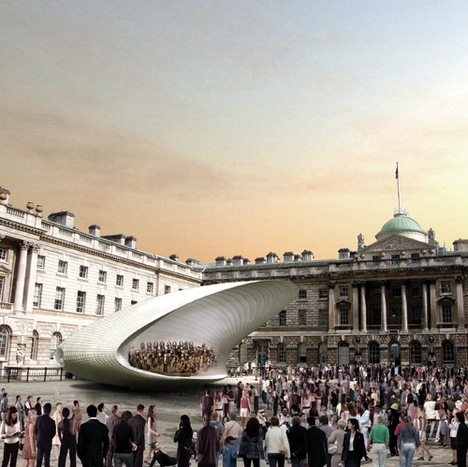
Knowles has teamed up with architect and director at Hamiltons Jason Flanagan, who has designed the stage; conductor and producer Mark Stephenson; and Olly Watts, director of ES Group, the world’s largest staging company, which made, installed and toured internationally Zaha Hadid’s Chanel Mobile Art enclosure.
The mobile performance shell has been some 10 years in the making, but it has only been in the last two years, since Flanagan joined the team, that the project has really stepped up, with the formation of the company Soundforms, which will market the stage.
The company is in the process of securing funding for a prototype stage, to be manufactured by ES Group, which it hopes will be available for classical performances next summer.
The medium-sized performance shell, weighing approximately 10 tonnes, will be designed to be erected over two days and dismantled in about 12 hours. It will be approximately 20m long x 16.8m wide, and able to accommodate a standard sized symphony orchestra of about 70 musicians. It will allow direct sound to be projected twice as far as standard outdoor mobile performance stages.
The team anticipates producing two other sizes of performance shells: a small version suitable for a quartet; and a large version, about 25m wide and 19.2m deep.
When it came to the design, Knowles says the key aim was to direct the sound energy away from the musicians and towards the audience. To do this, the shell needed a particularly generous performance space, combined with the peak or projecting roof, the design’s key innovation, which allows the sound to hit the peak and project out to the audience.
“This is something I’ve been working on with Mark [Stephenson] for 10 years,” says Knowles. “It’s been a work of love for me, and a desire to bring classical music to the masses in a professional way.
“I design concert halls for a living so if we can provide the best experience we can to an outdoor event that would be a great achievement.”
Construction stages of the modular elements
1. Platform
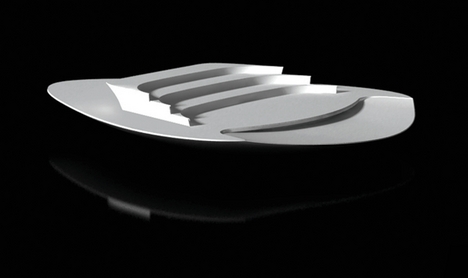
The first part of the mobile acoustic performance shell to be erected is the stage. This will be a modular scaffold flooring system composed of vertical steel legs, horizontal aluminium members and a phenolic faced plywood platform, which will all clip together. Attached to the aluminium members will be steel self-stacking tanks, filled with water to provide ballast against strong wind loads.
2. Steel structure

Next is the bespoke designed, largely steel truss system which will be pinned together to form the frame.
3. Inner shell
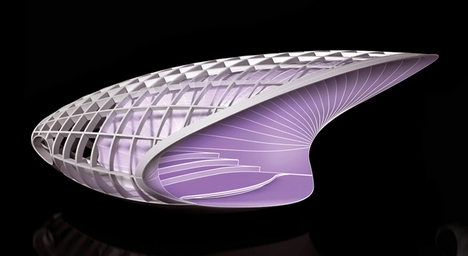
A decision is yet to be made on what material is used for the curved acoustic reflectors that will line the inside of the soffit and walls to the performance stage.
There is a strong preference for plywood, mainly because it is robust, easy to source and replace. Significantly, says Ian Knowles, timber is a material musicians play with and therefore they feel comfortable with a timber-clad environment.
Fibre-reinforced plastic is the other possibility.
But what the design team are sure about is that the 8ft x 4ft (2.4m x 1.2m) panels will all need to be curved in the same way in order to send the sound energy away to the audience. The panels will be clipped onto a framework lying on the ground and then the frame will be hoisted into place.
4. Outer shell
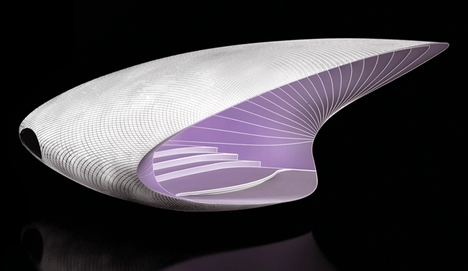
The final stage of the mobile performance shell’s assembly will involve cladding the frame with a skin, in this case it will probably be a PVC material that doesn’t provide any translucency. The material will be fitted using a luff track, which is an aluminium extrusion like a mast on a sailing ship.
The material will come in 25m-long, 6m-wide sections and once all the material is fixed, a sophisticated programmable fan will inflate the material.
While the performance space is in use, the fan, which runs at a low rate, will turn on intermittently.
From :Building design Journal