건축가여 그대의 건축으로 사람들이 감동받게 하라.Siza는 그렇게 하였다 한다 (필자)
2009-07-03
|
|

Architects’ inspirations
Peter Barber visits Alvaro Siza’s Faculty of Architecture in Porto
03 July 2009
By Pamela Buxton
Alvaro Siza’s University of Porto buildings triggered a transformation in Peter Barber’s ideas about architecture
Inspiration: Faculty of Architecture, University of Porto
Architect: Alvaro Siza
Built: 1987-1993
Location: Porto, Portugal
I first heard about Alvaro Siza from Liza Fior [now of Muf] whose dad lived in Porto when I was studying for my diploma at the Polytechnic of Central London. When I finally saw Siza’s work for myself it was a shock, completely alien to the hi-tech seventies and eighties stuff in England. There everything was about articulated structure and niftily detailed cladding systems, but Siza turns his structure into sculpture. His architecture seemed to be about concealment, seduction and poetry. He wanted to hide the technological and instead articulate pure form and space.

I’d been immersed in a functionalist environment for my first degree in Sheffield. I loved Archigram and had come to PCL to study under David Greene, and when I left I was interested in the idea of an architecture of ephemerality and lightness. My encounters with the work of Siza and also Luis Barragan while I was working for Richard Rogers made me look at architecture in a different way — the idea of mass and solidness — architecture embedded physically, culturally, geometrically in a particular site.
Having already seen other Siza buildings in Porto such as his wonderful salt water swimming pool and the Boa Nova tearooms, I visited the faculty of architecture in 1994 not long after it had opened. I’d never seen anything like it. Until then, the buildings I’d adored had been very different — more mechanistic, gadgetry, dominated by structure. Through Siza I came to enjoy buildings which are more enigmatic.
I found the Porto University buildings very moving. You feel as if the architect is speaking to you and exerting a subtle but profound influence as you walk around, as if his hand is in the small of your back coaxing you gently through as the spaces unfold in picturesque sequence. It’s a building you discover gradually. As I’ve come back five or six times over the years the subtleties of the building have slowly dawned on me as I’ve become more familiar with it. It’s so different to Koolhaas’s recently completed Casa da Musica in Porto which looks as if it’s crash landed from outer space. That is much more instantly understood than Siza’s work, which is more layered, complex, nuanced and locally embedded.
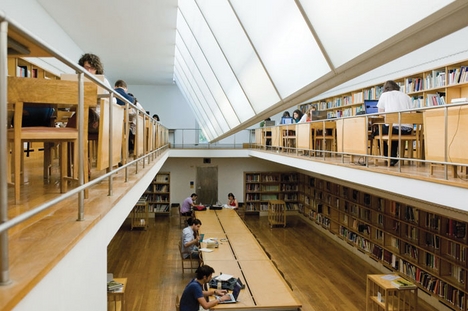
Siza is very quiet and self-assured and this building also has a quiet confidence about it, a subtlety that makes people look at it more carefully. When you walk into the central space, your pace quickens because it arouses your curiosity and you want to discover it. For me that is what is magical about architecture. I like architecture that throws curve balls — you think it’ll be one thing and it turns out to be something else. And there’s a lot happening — it looked like Siza pored over joints and junctions for days to get them right. One of my favourites is an informal meeting place or hallway below the fifth-year tower, the building’s principal point of circulation where numerous routes and axes converge and settle into a space teaming with people rushing through, stopping for a chat, sitting down for a cuppa. As such, it has an urban quality that I like. The arrangement of the buildings around a central square makes the faculty feel like a fragment of city.
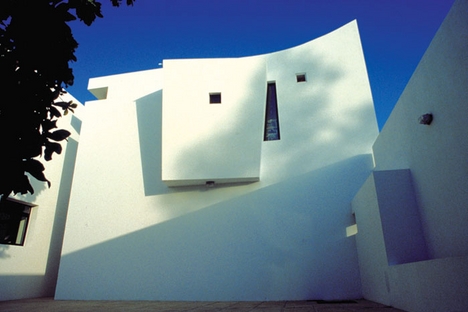
Siza has said that architecture is meaningless until it is occupied, and it seems to me that he thinks profoundly about how his spaces will be used. On a busy day, the central space is brought to life by students playing football and sitting out on the strange truncated tower. My early encounters with his buildings helped me to think about architecture this way.
In the context of a lot of public and education sector architecture in England, the Porto architecture faculty shows us how to make a place that’s calmly confident and lovingly made — civic and not corporate, unlike so many university buildings. I’d rather be here than in any other architecture school I’ve been in. But at the same time, is there a tyranny here in that students are in a Siza building and they’re being taught in a Siza way?
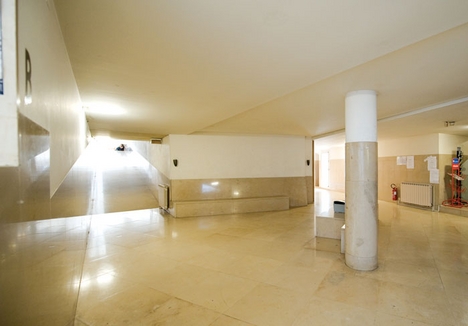
When I visited the architecture faculty, it helped me consolidate my enthusiasm for an architecture of solidity, and my determination to work with mass and simple form. After working for Rogers and Alsop I set up my own practice and travelled to Saudi Arabia where I spent a year building my first project,Villa Anbar, which I think shows Siza’s influence.
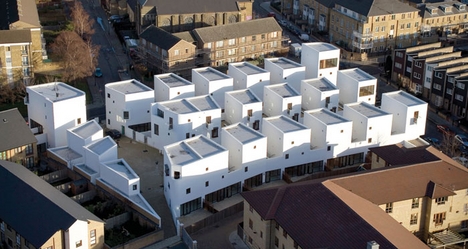
A lot of our work is about streets and public space, and I love the generosity of the Siza building. It is part of the city’s public space of the city and we are invited to walk through it. I like to think that my own urban housing projects are conceived in this spirit. Donnybrook and Tanner Street in east London and the project that predates them — a masterplan for Haggerston West and Kingsland estates in Hackney — are all conceived as pieces of city knitted into their surroundings.
|
“Siza has said that architecture is meaningless until occupied, and it seems to me he thinks profoundly about how his spaces will be used” |
The design of the Porto faculty is very knowing. It’s redolent of the Porto streetscape and there are shades of Loos, Alto and Corb in it. Maybe it’s an architects’ architecture. The campus continues to fascinate me and I’m sure it won’t be long before I’m back. But you have to keep moving on. I’m getting really interested in “home made” self-build housing and I’m also fascinated by the tumultuous street life made possible by a really dense city like Marrakech which I visited a couple of months ago.
Porto’s towers of learning
Alvaro Siza was an appropriate choice to create a new architecture faculty at Porto, having studied at the university before establishing his practice in the city in 1954.
The faculty covers 87,000sq m on a sloping site overlooking the Douro. It is one of a series of large-scale institutional projects Siza took on in the 1980s. He initially conceived the accommodation as a single large-scale building with inner courtyard, but developed the design further into a number of smaller, interlinked volumes.
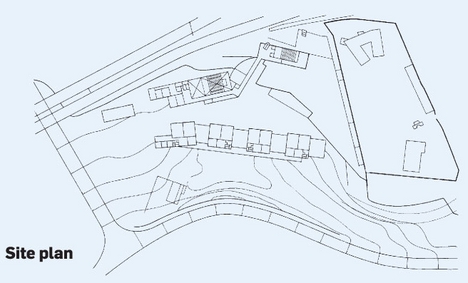
Teaching and architectural research takes place in a row of studio towers with great views of the river, each with varying heights and window openings according to function. Departmental offices, lecture halls, an auditorium and a library are arranged behind them within the north wing, which acts as an acoustic buffer to a busy road running behind the site. On the top floor is the fifth year studio.
All four towers are linked at basement level by a generous corridor which converges with the basement circulation of the north wing. All circulation spaces are clad and floored in Travertine marble. Above ground, a central meeting space is semi-enclosed between the north building and the towers. Students also congregate on a platform between two of the towers and in a café pavilion and outdoor terrace situated at the main entrance where the two wings converge. Years are accommodated in their own buildings with second- year students occupying an earlier project by Siza, the Carlos Ramos Pavilion. This is reached via an elevated grass platform through a gate in the top of the site which leads to the former site of the architecture school.
Generally considered to be Portugal’s greatest architect, Siza was awarded the RIBA Gold Medal in 2009 and the Pritzker Prize in 1992. He completed the faculty in 1993, and until recently continued to teach at the School of Architecture. The faculty was originally intended for 500 students, but now has twice that number and needs to expand. There are plans to invite Siza to design further accommodation on a nearby vacant site, and the existing buildings are shortly to undergo repairs.
Peter Barber was speaking to Pamela Buxton.
Original print headline - ‘You feel as if the architect is speaking to you’