3.66m x3.66m의 작은 별장..그의 부인을 위한 ...Le Corbusier...1:1(replica ) 실물을 재구성했다고 하니 한번 가보고 싶네요.
2009-03-16
|
|

INSTALLATION PREVIEW
Le Corbusier’s Le Cabanon at the RIBA
13 March 2009-----29,April,2009(영국 RIBA)까지 전시합니다. 별장의 크기도 깍두기 사이즈이려니와
인테리어의 미니멀리즘은 위대한 건축가의 또다른 창의력을 보입니다.
By Pamela Buxton
Le Cabanon, the French Riviera beach home Le Corbusier built for his wife in the 1950s, arrives at the RIBA in a 1:1 reconstruction
Installation
Le corbusier’s cabanon 1952/2006 The interior 1:1
RIBA, 66 Portland Place, London W1
Le Corbusier loved the seaside. Every August, he’d leave Paris for a month and head for the coast — as documented in famous photos of him relaxing on the beach in eccentric bathing costumes. Between 1952 and 1965, he enjoyed holidaying at his very own retreat, Le Cabanon, a sort of glorified bathing hut with fabulous views of the Bay of Monaco and a handy through-door to an adjacent restaurant.
This charming piece of micro-architecture is still there, and is overrun with archi-tourists. It arrived this week at the RIBA in the form of a one-to-one reconstruction by Cassina, the Milan furniture company, which holds the licence for Corbusier products.
Italian architect Filippo Alison, curator of Cassina’s I Maestri collection — which also includes pieces inspired by Mackintosh, Perriand, Rietveld, Asplund and Albini — was instrumental in recreating the Cabanon for Cassina, working closely with the Corbusier Foundation.
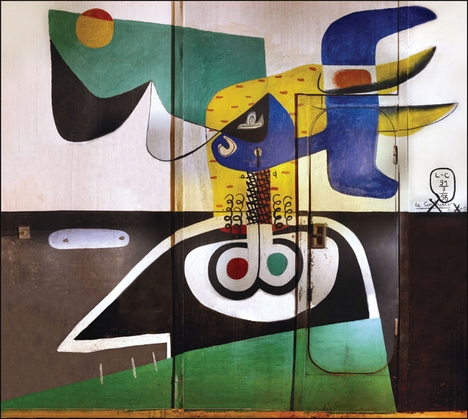
The result was first shown at the Milan furniture fair three years ago, and has been touring ever since. It is not an exact replica — oak and walnut furniture replaces chestnut and olive — but it offers a chance to experience one of Corbusier’s most intimate and personal spaces, where he spent his last night before his death while swimming in 1965.
For Corbusier scholar Arthur Rüegg, co-curator of the major Corbusier exhibition now showing at the Barbican, the Cabanon is “a beautiful box” whose minimalism reflects the architect’s core values and remains relevant to contemporary lifestyles.
“The question of minimalism is very interesting — on the one hand the smallness, but also a very reduced form of living. It’s about living with a very few things and a nomadic, reduced lifestyle, and that’s something that interests people very much today,” says Rüegg.
Le Cabanon was built in 1952, measures just 15sq m, and reputedly took half an hour to design. Corbusier already knew the Roquebrune-Cap Martin area, having worked with Eileen Gray on her E.1027 house.
He chose to build himself a holiday cabin adjoining the newly opened Etoile de Mer restaurant, where he would take all his meals.
“We focused on the interiors,” says Alison, “almost excluding the reconstruction of external parts, reducing them to the lowest terms, a neutral container. Le Cabanon — conceived, designed and built by the same architect who lived in it — embodies the ideal conditions of the architectural design, the synthesis of the dialectic between design, momentum and use.”
On the outside, it is like a primitive hut. Inside, while there is no kitchen or heating and only a chromed steel basin and toilet, it is nonetheless very sophisticated in its use of minimal space and box-like multifunction furniture. The interior is plywood, the oak floor is painted yellow, and the ceiling is painted in white, blue and green, and conceals storage space. Within the cabin are wooden boxes, some fixed like the wardrobe, and a built-in table; some movable like the wheeled chest, the stool/table and the bed, which doubles as storage. A mirror on one side of the folding shutters offers views inward or outward, depending on their position. Lighting specially designed for Le Cabanon could be adjusted to work either as uplighters or downlighters.
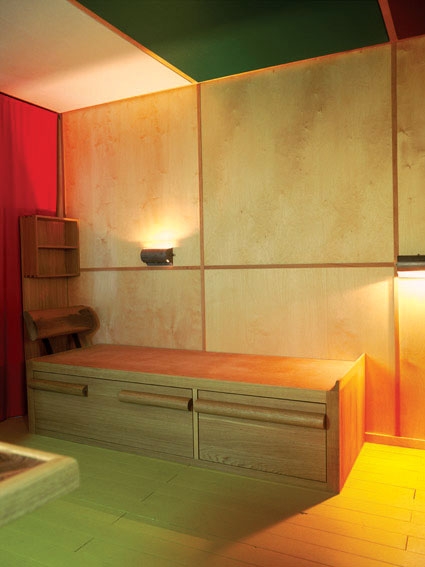
“It’s a chance to be Corbusier and occupy the space where he designed some of his later buildings,” says RIBA exhibitions curator Rob Wilson. “It’s very, very simple. But it’s very modern.”
The RIBA has attempted to contextualise the installation, which is open for visitors to sit in and is accompanied by archive images and explanatory material. Instead of going to the original restaurant, visitors can repair to the RIBA café instead. But even if sand and beach balls were added, it could never quite compete with the real thing, with its stunning views of the Mediterranean, where Corbusier swam every day while at his cabin.
Alison quotes Corbusier as saying: “I have a castle on the Riviera of 3.66m by 3.66m. It is for my wife, has outstanding comfort and is out of the ordinary.” Judge for yourself.
- Equipping the Cabanon:Its Interior & Furniture, a lecture by Arthur Rüegg, is at the RIBA, March 23. Le Corbusier — Il Maestro, an exhibition of his furniture from the Cassina collection, is also at the RIBA till April 28.
- Corb’s sand castle