류경호텔...평양 소재....세계 최고층 (완공안되고,방치되어 있는 기준으로) 콘크리트 빌딩
2008-08-26
By Dorian Davis..(Architectural Record magazine by published by McGraw-Hill)
Beijing has erected a dizzying array of striking architectural landmarks in preparation for this month’s Summer Games. Roughly 500 miles east of Beijing, in an aging city in North Korea, a similar attempt to capitalize on Olympic tourism two decades ago met a different end.
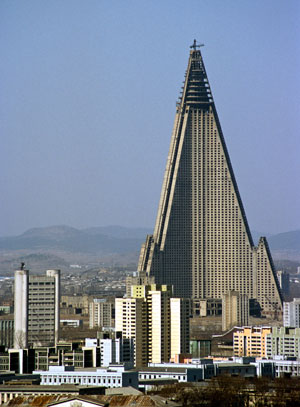
But Ryugyong wasn’t finished in time for the Olympics. Then, in 1992, construction came to a halt when the government ran short on funding. The building’s concrete skeleton has loomed over Pyongyang ever since, a dismal reminder of failed ambitions. Once destined to become a superlative hotel, Ryugyong is now the tallest abandoned building in the world.
North Korea became tight-lipped about the project and allegedly removed Ryugyong from official Pyongyang maps. Its secrecy has only spurred international interest. The hotel has inspired Web sites, such as ryugyong.org, and is featured in several videos on YouTube.com. In June 2005, Italy’s Domus magazine put the building on its cover, after organizing a competition with the Politechnic of Milan that asked architects to submit ideas for hotel. This past January, Esquire magazine’s Eva Hagberg called it “the worst building in the world.”
Now, as Seoul once again prepares for international attention—after being named World Design Capital 2010—the Institute for Far Eastern Studies reports that North Korea plans to revive work on its monster building with the help of the Egypt-based development outfit Orascom Group. This report, however, picked up by various news outlets, appears to be false. “Orascom is not related to or involved in operations or hotel developments in North Korea,” says Mamdouh Abdel Wahab, the company’s director of investor relations.
For those fascinated with the “Phantom Pyramid,” as some have called Ryugyong, the rumor might be a case of wishful instead of rational thinking. Even if the government of North Korea—where 25 percent of the population faces famine, according to the United Nation’s World Food Program—had the estimated $300 million needed to finish Ryugyong, it could encounter big obstacles. First and foremost, it would need to repair an enormous structural frame that has been exposed to the elements for 20 years. “That can be tricky with a concrete building,” explains architect Eric Howeler, AIA, author of Skyscraper: Vertical Now. Plus there is no guarantee that the hotel would be profitable. Just 2,000 Westerners visited North Korea in 2007— a fraction of the number needed to keep the “Hotel of Doom” in business for the long haul, let alone fill it on a single night.